NP-Hard Problems#
This page collects examples and patterns for classic NP-hard optimization problems.
Several basic examples are already covered in the existing galleries:
Example 02: Knapsack for 0/1 knapsack
Example 03: Minimum Set Cover for minimum set cover
Example 04: Minimum Vertex Cover for minimum vertex cover
Example 12: WiFi Channel Assignment for graph-coloring channel assignment
CVRP for routing with MTZ load constraints
Example 01: Job Shop Scheduling#
A job shop scheduling model with machine conflicts, per-job operation order, and a makespan objective.
New primitives#
Model#
Each job is a sequence of operations. Each operation must run on one machine for a given duration, operations of the same job must respect their order, and operations that share a machine cannot overlap.
This is one of the classic NP-hard scheduling problems [5], and it is a good fit for interval variables because the model is fundamentally about start times, end times, and resource conflicts.
Note
This example uses hermax.model.Model.upper_bound() instead of an exact
max(...) aggregate. Under minimization, that is often the cleanest way
to model makespan: the optimizer will push the upper bound down to the true
schedule end automatically. An exact aggregate is still useful when the
maximum value itself needs to be reused elsewhere in the model.
Code#
from hermax.model import Model


jobs = {
    "J1": [("M1", 3), ("M2", 2), ("M3", 2)],
    "J2": [("M2", 2), ("M3", 1), ("M1", 4)],
    "J3": [("M3", 4), ("M1", 3), ("M2", 1)],
}

horizon = sum(duration for ops in jobs.values() for _, duration in ops)

m = Model()
ops = {}
machine_ops = {"M1": [], "M2": [], "M3": []}

for job, route in jobs.items():
    for step, (machine, duration) in enumerate(route):
        task = m.interval(f"{job}_{step}", start=0, duration=duration, end=horizon)
        ops[(job, step)] = task
        machine_ops[machine].append(task)

for job, route in jobs.items():
    for step in range(len(route) - 1):
        m &= ops[(job, step)].ends_before(ops[(job, step + 1)])

for machine, tasks in machine_ops.items():
    for i in range(len(tasks)):
        for j in range(i + 1, len(tasks)):
            m &= tasks[i].no_overlap(tasks[j])

makespan = m.upper_bound(
    [ops[(job, len(route) - 1)].end for job, route in jobs.items()],
    name="makespan",
)

m.obj[1] += makespan

r = m.solve()

print("status:", r.status)
print("makespan:", r[makespan])
for job, route in jobs.items():
    print(job + ":")
    for step, (machine, duration) in enumerate(route):
        task = ops[(job, step)]
        slot = r[task]
        print(
            f"  op{step + 1}: {machine} dur={duration} "
            f"start={slot['start']} end={slot['end']}"
        )
Output#
The printed schedule shows the operation order inside each job and the final makespan.
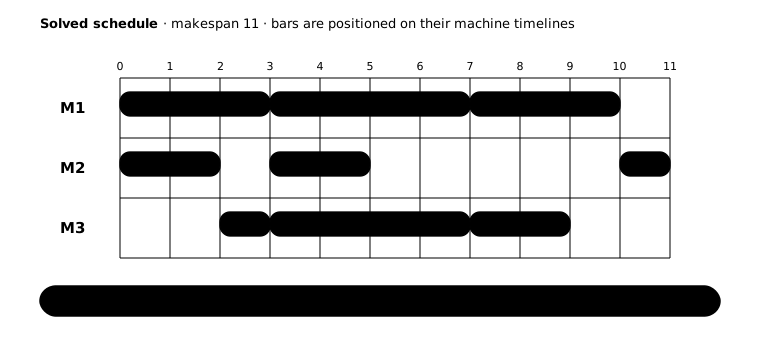
$ python examples/model/26_job_shop_scheduling.py
status: optimum
makespan: 11
J1:
  op1: M1 dur=3 start=0 end=3
  op2: M2 dur=2 start=3 end=5
  op3: M3 dur=2 start=7 end=9
J2:
  op1: M2 dur=2 start=0 end=2
  op2: M3 dur=1 start=2 end=3
  op3: M1 dur=4 start=3 end=7
J3:
  op1: M3 dur=4 start=3 end=7
  op2: M1 dur=3 start=7 end=10
  op3: M2 dur=1 start=10 end=11
Example 02: Bin Packing#
A bin packing model with item-to-bin assignment variables, bin capacity constraints, and symmetry break.
New primitives#
Model#
Each item must go in exactly one bin. Every bin has the same capacity. The objective is to minimize the number of bins used.
Bin packing is an NP-hard problem [1], and it is also a common benchmark for approximation algorithms [2].
Note
The symmetry break says that bin b+1 cannot be used unless bin b is
already used. This does not change the set of achievable packings, but it
removes many equivalent bin permutations and usually helps search.
Code#
from hermax.model import Model


sizes = [4, 8, 1, 4, 2, 1]
capacity = 10
num_items = len(sizes)
num_bins = num_items

m = Model()
place = m.bool_matrix("place", num_items, num_bins)
used = m.bool_vector("used", num_bins)

for i in range(num_items):
    m &= place.row(i).exactly_one()

for b in range(num_bins):
    m &= sum(sizes[i] * place[i][b] for i in range(num_items)) <= capacity
    for i in range(num_items):
        m &= place[i][b].implies(used[b])

for b in range(num_bins - 1):
    m &= used[b + 1].implies(used[b])

for b in range(num_bins):
    m.obj[1] += ~used[b]

r = m.solve()

print("status:", r.status)
print("bins_used:", sum(1 for b in range(num_bins) if r[used[b]]))
for b in range(num_bins):
    if r[used[b]]:
        items = [i for i in range(num_items) if r[place[i][b]]]
        load = sum(sizes[i] for i in items)
        print(f"bin {b}: items={items} load={load}/{capacity}")
Output#
The result shows the number of bins used and one concrete packing.
$ python examples/model/27_bin_packing.py
status: optimum
bins_used: 2
bin 0: items=[1, 4] load=10/10
bin 1: items=[0, 2, 3, 5] load=10/10
Example 03: Maximum Clique#
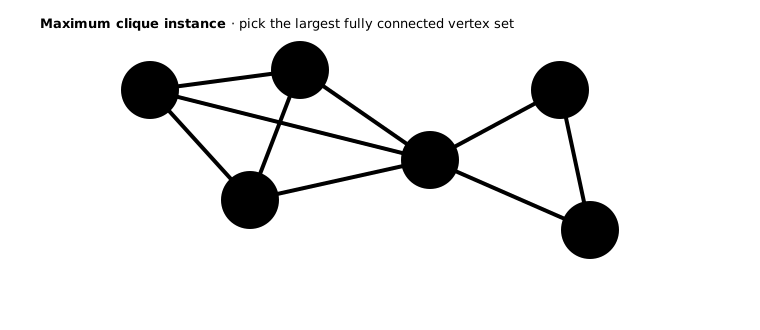
A graph model where the goal is to select the largest fully connected group of vertices.
New primitives#
Hard clauses over graph decisions
Soft unit objective terms for cardinality maximization
Model#
Each vertex has one Boolean decision. If two vertices are not connected by an edge, they cannot both belong to the clique. The objective is to maximize the number of selected vertices.
The maximum clique problem is one of Karp’s original NP-complete problems [3] and is a common graph optimization benchmark [4].
Note
Maximum clique and maximum independent set are two sides of the same graph idea. An independent set in a graph is a clique in its complement.
Problem#
Code#
from hermax.model import Model


vertices = [0, 1, 2, 3, 4, 5]
edges = {
    (0, 1),
    (0, 2),
    (0, 3),
    (1, 2),
    (1, 3),
    (2, 3),
    (3, 4),
    (3, 5),
    (4, 5),
}

edge_set = {tuple(sorted(e)) for e in edges}

m = Model()
pick = m.bool_dict("pick", vertices)

for i in range(len(vertices)):
    for j in range(i + 1, len(vertices)):
        u = vertices[i]
        v = vertices[j]
        if (u, v) not in edge_set:
            m &= (~pick[u] | ~pick[v])

for v in vertices:
    m.obj[1] += pick[v]

r = m.solve()

clique = [v for v in vertices if r[pick[v]]]
print("status:", r.status)
print("size:", len(clique))
print("clique:", clique)
Output#
The result shows one maximum clique found in the example graph.
$ python examples/model/28_maximum_clique.py
status: optimum
size: 4
clique: [0, 1, 2, 3]
Solution#